Agricultural loans for farmers help rural operations manage the costs of planting, equipment, land, livestock, and day-to-day farm needs. Agriculture is the backbone of many rural Indiana communities, and access to the right financing can help farms and agribusinesses stay steady through changing seasons.
Farm financing is not the same as a standard consumer loan. Farm income can be seasonal. Crop yields can vary. Equipment costs can be significant. Land purchases often require long-term planning.
Springs Valley Bank & Trust has deep roots in rural Indiana and a history of supporting local farmers and agribusiness owners with practical lending guidance. The bank understands that agricultural lending must account for the farming cycle, local land values, and the realities of operating in a rural market.
All loans are subject to credit approval, underwriting standards, collateral requirements, and applicable program eligibility. Terms, conditions, rates, and availability may vary by loan type and borrower qualifications.
This guide covers:
- What are agricultural loans for farmers?
- How do farm loans work?
- Types of agricultural loans available.
- Farm loan requirements and eligibility.
- USDA Farm Service Agency loan programs.
- Agricultural loans vs commercial business loans.
- How to apply for a farm loan.
- Benefits of agricultural lending for rural communities.
What Are Agricultural Loans for Farmers?
Agricultural loans are financing products designed for farms, ranches, and agribusinesses. They can support operating costs, equipment purchases, land acquisition, livestock needs, crop production, and other farm-related expenses.
These loans are often structured around the way farm income works. That matters because a farm may spend heavily before revenue comes in.
Definition and Core Purpose
The main purpose of agricultural lending is to help farmers access capital when they need it.
A farm may need funds for seed, fertilizer, fuel, repairs, land, buildings, or equipment. A livestock operation may need financing for feed, breeding stock, facilities, or veterinary costs.
Agricultural loans for farmers can help bridge the gap between seasonal expenses and future income. They can also help established operations make long-term improvements.
Who Uses Agricultural Loans?
Agricultural loans may be used by a wide range of borrowers, including:
- Row crop farmers
- Livestock producers
- Beginning farmers
- Family farms
- Agribusiness owners
- Farm operators buying land
- Farmers replacing or upgrading equipment
- Producers recovering from a difficult season
The loan type depends on the operation’s needs. A short-term operating loan is different from a land loan. Equipment financing is different from a line of credit.
Agricultural Lending in Rural Indiana
Agricultural lending in rural Indiana often requires local knowledge. Land values, crop patterns, weather risks, and local market conditions can affect how a farm plans and borrows.
A local agricultural lender may ask more locally informed questions because they understand the region. That can help farmers review the right financing option before they commit to a major purchase or operating plan.
Springs Valley Bank & Trust supports rural Indiana customers with local service and agricultural financing built around real farm needs. Financing options are subject to credit approval, underwriting, collateral, and applicable loan documentation requirements.
How Do Farm Loans Work?
Farm loans work by matching the financing structure to the farm’s purpose, repayment source, and timing.
A lender reviews the borrower’s financial position, farm plan, repayment ability, collateral, and loan purpose. Then the lender recommends a structure that fits the operation.
The details depend on the lender, credit approval, business qualifications, and loan agreement. Approval, credit limits, and terms are determined based on the applicant’s financial condition, collateral, repayment ability, loan purpose, and creditworthiness. Consumer-purpose, dwelling-secured, commercial-purpose, and agricultural-purpose loans may be subject to different documentation, disclosure, appraisal, flood insurance, and servicing requirements.
Application to Approval Timeline
The timeline depends on the loan type and the complexity of the request.
A simple farm operating loan may move faster than a farmland purchase or a government-guaranteed loan. A larger request may require more documentation, appraisal work, title review, environmental review, flood determination or flood insurance review where applicable, or agency approval.
Farmers can help the process by preparing documents early. Clear records may make the review easier.
Disbursement and Seasonal Repayment Terms
Farm loans may be disbursed in different ways.
An operating loan may provide access to funds during the growing season. Equipment financing may pay the dealer or seller at purchase. A real estate loan may fund at closing.
Repayment may also reflect the farm’s income cycle. Some operations have income after harvest. Others receive livestock, dairy, custom work, or agribusiness revenue throughout the year.
Seasonal repayment terms may help align loan payments with expected farm cash flow.
Interest Rate Structures for Farm Loans
Farm loan rates may be fixed or variable, depending on the loan type, term, market conditions, collateral, repayment structure, and borrower qualifications.
A fixed rate can provide predictable payments. A variable rate may change over time based on the loan agreement.
Farmers should ask how the rate works, when it can change, and how that could affect repayment.
Rates, margins, and adjustments may vary and may increase payment amounts over time. Borrowers should review loan documentation for full details on rate calculations, adjustments and whether any fees apply.
Types of Agricultural Loans Available
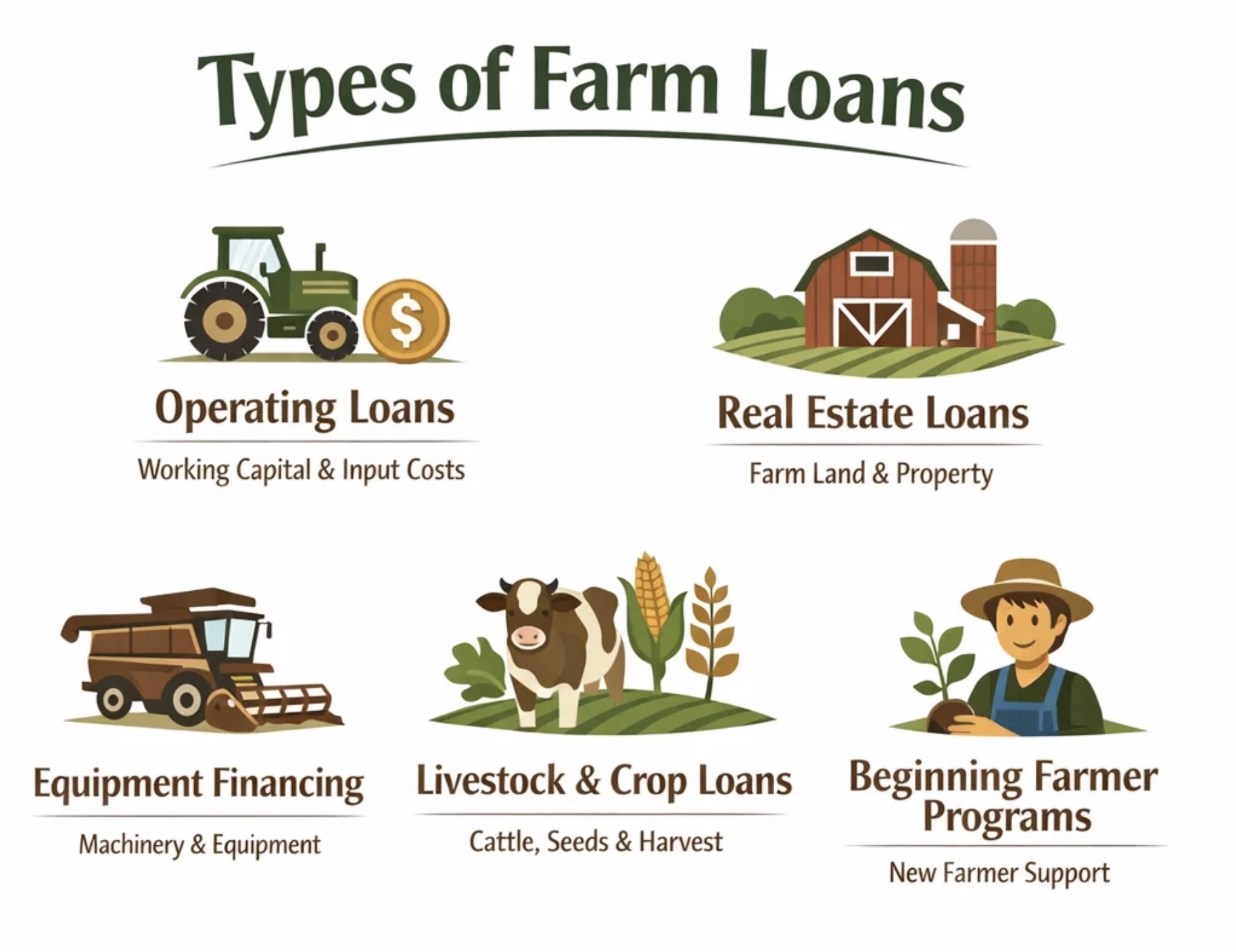
The types of agricultural loans available depend on the farm’s purpose, collateral, repayment source, and borrower qualifications. A loan for annual inputs should not be structured the same way as a loan for land or equipment.
A lender can help match the loan to the useful life of what is being financed.
Farm Operating Loans
Farm operating loans may help cover short-term expenses. These may include seed, fertilizer, chemicals, fuel, feed, labor, repairs, crop insurance, and other seasonal costs.
These loans are often repaid when the farm receives income from harvest, livestock sales, or other operating revenue.
A farm operating loan may help a farmer keep the operation moving during high-expense periods.
Farm Real Estate Loans
Farm real estate loans may help farmers purchase farmland, expand acreage, refinance farm property, or improve land and buildings. Real estate-secured loans may require appraisal or evaluation review, title work, flood determination, insurance, environmental review, and other documentation depending on the property and loan structure.
These loans usually have longer repayment terms because land is a long-term asset.
A lender may review the property, appraisal, farm income, collateral, and long-term repayment ability before approving a farm real estate loan.
Agricultural Equipment Financing
Agricultural equipment financing may help farmers buy or replace machinery.
This may include tractors, planters, combines, tillage equipment, hay equipment, trailers, irrigation equipment, and other farm tools.
The financing term should generally match the equipment’s useful life. A lender may review the age, condition, value, and role of the equipment in the operation.
Livestock and Crop Production Loans
Livestock and crop production loans support the direct costs of producing income.
Crop production loans may fund inputs before harvest. Livestock loans may help with feed, breeding stock, facilities, or herd expansion.
These loans should reflect the production cycle. A cattle operation may have a different repayment pattern than a grain operation.
Farm Loan Requirements and Eligibility
Farm loan requirements vary by lender, loan type, and program. A farm real estate loan may require different documentation than an operating loan or equipment loan.
The main question is whether the operation can support the loan request.
Credit History and Farm Business Plan
A lender will usually review credit history. Credit helps show how the borrower has managed past obligations.
The farm business plan also matters. It should explain what the farm produces, how income is earned, what the loan will fund, and how repayment will happen.
Beginning farmers may need to rely more heavily on a written plan, projected income, and available support programs.
Cash Flow Analysis and Collateral
Cash flow analysis helps the lender understand whether the farm can repay the loan.
The lender may review income, expenses, existing debt, crop or livestock sales, input costs, insurance, and other obligations.
Collateral may include land, equipment, livestock, crops, or other business assets. Collateral requirements depend on the loan structure and borrower profile.
Years in Operation and Farm Revenue
An established farm may have several years of records. That can help a lender review trends, production history, and repayment ability.
A newer farm may have fewer records. In that case, the lender may rely more on projections, outside income, collateral, FSA options, or other support.
Farm revenue matters, but it is not the only factor. A lender will also consider debt levels, expenses, management experience, and the purpose of the loan.
USDA Farm Service Agency Loan Programs
The USDA Farm Service Agency (FSA) programs can help farmers who need access to credit and meet program requirements. USDA/FSA programs are subject to eligibility, funding availability, program rules, deadlines, documentation requirements, and USDA/FSA approval where applicable. Springs Valley Bank & Trust is not the USDA or FSA.
The USDA Farm Service Agency says it offers farm loan programs to help farmers and ranchers start, expand, or maintain a family farm.
These programs can be especially helpful for beginning farmers, smaller operations, and producers who cannot obtain credit elsewhere under reasonable terms.
FSA Direct Loans vs. Guaranteed Loans
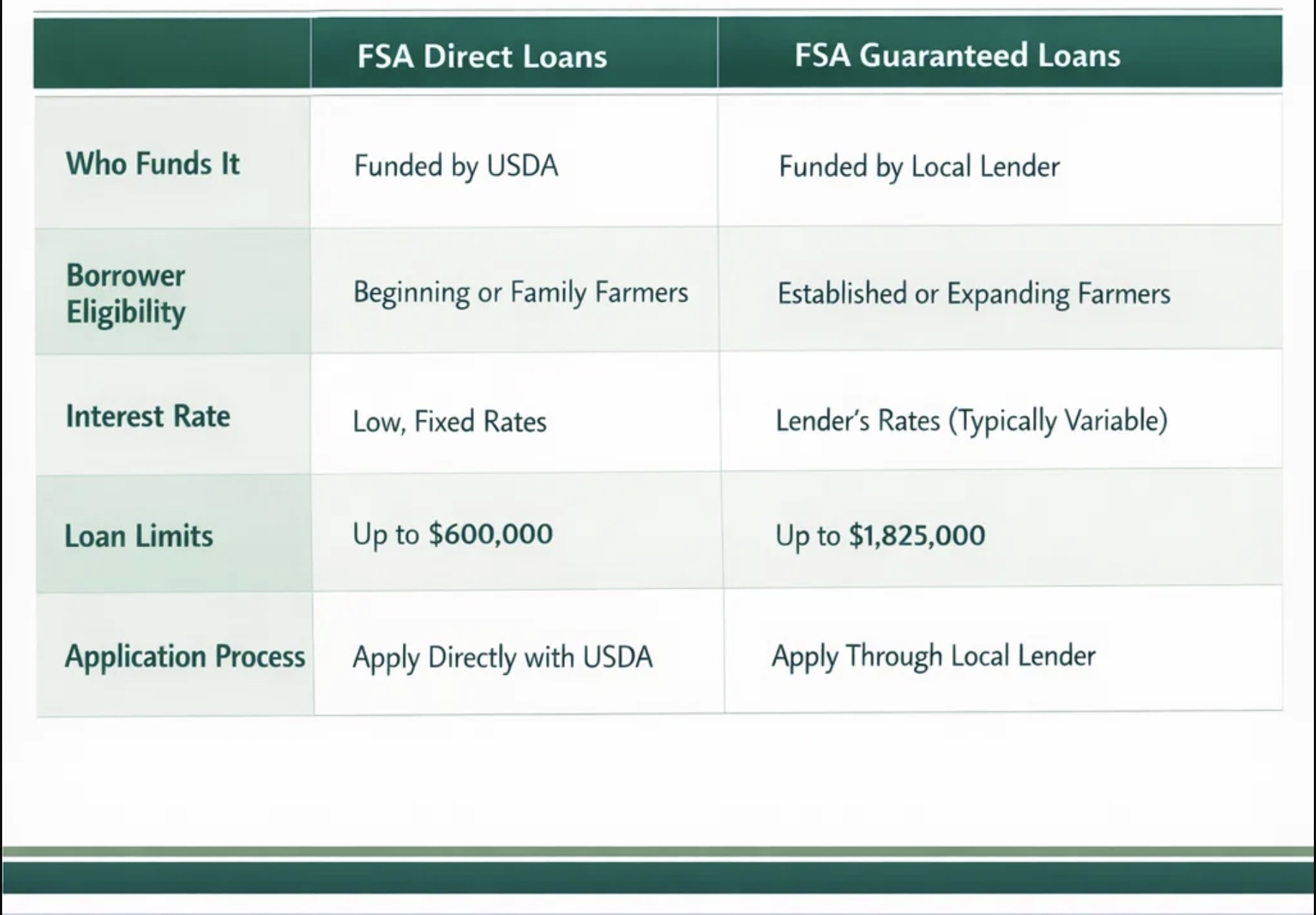
FSA direct loans are made and serviced by USDA Farm Service Agency offices.
FSA guaranteed loans are made by USDA-approved commercial lenders, and FSA provides a government guarantee, subject to program requirements. A government guarantee does not guarantee borrower approval, does not eliminate borrower repayment obligations, and does not mean every applicant or loan request will qualify. USDA says guaranteed farm loan programs help family farmers and ranchers obtain loans from USDA-approved commercial lenders to buy farmland or finance agricultural production.
The right option depends on the borrower’s needs, eligibility, and lender relationship.
Emergency Farm Loans for Crop Loss
FSA emergency farm loans may help eligible producers recover from qualifying disasters.
The USDA says emergency loans can help farmers and ranchers recover from production and physical losses caused by drought, flooding, storms, and other natural disasters. Loan funds may help replace property, cover production losses, or support recovery needs, subject to program rules.
Farmers should contact their local FSA office or lender after a qualifying disaster to understand deadlines, documentation, eligibility, loan limits, and available recovery options. Emergency loan availability depends on USDA/FSA disaster designation, program requirements, and borrower eligibility.
Microloan Programs for Small Operations
The USDA says microloans can be used for farm operating and farm ownership needs and are designed to meet the needs of small, beginning, nontraditional, or specialty operations by easing some requirements and offering less paperwork. Microloan applicants must still meet applicable FSA eligibility, documentation, repayment, and program requirements.
Microloans may be useful for small farms, specialty crop operations, local food producers, or beginning farmers building a track record.
Agricultural Loans vs Commercial Business Loans
Agricultural loans vs. commercial loans is an important comparison for farm operators and agribusiness owners.
Both can support business needs. But they are not always structured the same way.
How They Differ in Terms and Structure
Commercial business loans often support business equipment, working capital, real estate, expansion, or cash flow needs.
Agricultural loans are built around farm-specific needs. They may account for production cycles, land, crops, livestock, equipment, and seasonal income.
A farm loan may also involve FSA guarantees or agricultural collateral that a general business loan may not use in the same way.
Why Farm Loans Need Seasonal Flexibility
Farm income is often seasonal. Expenses may happen months before revenue arrives.
For example, a grain farmer may spend heavily in the spring and receive income after harvest. A livestock producer may have a different sales cycle. A farm with custom work, storage income, or multiple revenue streams may need another structure.
Seasonal flexibility helps the loan fit the farm instead of forcing the farm into a repayment schedule that does not match revenue.
Which Type of Loan Fits Your Operation?
The right loan depends on the borrower’s business model.
A farm operator may need agricultural financing for land, equipment, or inputs. An agribusiness may need commercial business loans for inventory, facilities, working capital, or expansion.
Some businesses may need both. A local lender can help review the operation and discuss available structures that may fit the purpose of the funds, subject to credit approval and applicable loan requirements.
How to Apply for a Farm Loan
Farmers asking how to apply for a farm loan should start with preparation. A clear request and complete records can improve the lending conversation.
The process is easier when the farmer knows the purpose, amount, timing, and repayment source. Submitting information or discussing options is not a commitment to lend. A completed application, underwriting review, approval, and signed loan documents are required before loan proceeds are available.
Step 1, Review Your Farm's Financial Position
Before applying, farmers should review income, expenses, debt, assets, and cash flow.
They should also consider what the loan will do for the operation. A loan for seasonal inputs has a different goal than a loan for land, equipment, or herd expansion.
A farm’s financial position should show how the loan supports the operation and how repayment will happen.
Step 2, Identify the Right Loan Type
The next step is choosing the right loan type.
Options may include:
- Farm operating loans
- Farm real estate loans
- Agricultural equipment financing
- Livestock financing
- Crop production financing
- FSA direct loans
- FSA guaranteed loans
A lender can help farmers compare the differences and decide which option fits the request.
Step 3, Gather Required Documents
Farm loan documents may include:
- Personal financial statement
- Farm balance sheet
- Tax returns
- Profit and loss statements
- Cash flow projections
- Production history
- Debt schedule
- Equipment list
- Land or lease details
- Farm business plan
- Purchase agreement, invoice, or project estimate
Documentation requirements for farm loans vary based on the loan request and individual circumstances. Additional information may be required to support the Bank's underwriting process, including documentation related to collateral, ownership structure, guarantors, appraisals, environmental or flood reviews, and government-guaranteed lending programs such as USDA or FSA financing.
Step 4, Work With a Local Agricultural Lender
A local agricultural lender can review the request, explain options, and help the farmer understand next steps.
Springs Valley can work with farmers as requested to review agricultural financing needs and identify available options that may fit the farm’s purpose and cash flow, subject to credit approval, underwriting, collateral, documentation, and applicable program requirements.
Customers can contact Springs Valley Bank & Trust or visit any Springs Valley branch to start a farm lending conversation.
Benefits of Agricultural Lending for Rural Communities
The benefits of agricultural lending reach beyond individual farms.
When farms have access to responsible financing, rural communities can remain stronger. Local farm operations support jobs, vendors, equipment dealers, grain facilities, food systems, and small businesses.
Supporting Local Food Systems and Employment
Farms support rural employment directly and indirectly.
A farm may hire seasonal help, buy supplies locally, use local repair services, work with feed suppliers, or support processors and transportation providers.
Agricultural lending can help farms keep operating, invest in equipment, and manage seasonal expenses. That activity supports the broader rural economy.
Long-Term Economic Stability for Rural Indiana
Agriculture is often tied to long-term community stability.
Family farms may operate across generations. Farmland may stay productive for decades. Agribusinesses may support many nearby families.
Responsible agricultural lending can help farms adapt to new conditions, replace aging equipment, recover from difficult seasons, and plan for the future.
How Springs Valley Supports Farmers Year-Round
Springs Valley supports farmers with local service and agricultural lending experience. The bank understands that farm needs do not fit a one-size schedule.
Farmers may need operating support in one season, equipment financing in another, and long-term land financing as the operation grows.
Springs Valley also offers related financial resources, including agricultural savings accounts, agricultural checking accounts, and digital business banking. Deposit products and loan products are subject to separate terms, disclosures, fees, and eligibility requirements.
FAQs
Springs Valley Bank & Trust Company is an Equal Housing Lender and Member FDIC. Loans are subject to credit approval. Loans are not deposits and are not insured by the FDIC.
What Are Agricultural Loans for Farmers, and How Do They Work?
Agricultural loans for farmers are specialized financing products used to fund the operating, equipment, land, livestock, crop production, and capital needs of farm businesses.
Unlike many standard business loans, agricultural loans may account for seasonal income cycles. Repayment can be structured around harvest, livestock sales, or other farm revenue timing, depending on the loan and borrower qualifications.
What Are the USDA Farm Service Agency Loan Programs Available to Farmers?
The USDA Farm Service Agency offers several farm loan programs, including direct loans, guaranteed loans, emergency loans, and microloans.
Direct loans are made through FSA. Guaranteed loans are made by approved lenders and backed by FSA. Emergency loans may help eligible farmers recover from qualifying disasters. Microloans may help smaller, beginning, niche, or nontraditional farm operations.
What Do Farmers Need to Qualify for an Agricultural Loan?
Most agricultural lenders review credit history, farm income, cash flow, collateral, debt levels, management experience, and the purpose of the loan.
A farm business plan may also be required, especially for beginning farmers or major expansion requests. FSA programs may offer options for eligible borrowers who have limited credit history or collateral.
What is the Difference Between a Farm Operating Loan and a Farm Real Estate Loan?
A farm operating loan is usually used for short-term needs such as seed, fertilizer, fuel, feed, labor, repairs, and other seasonal expenses.
A farm real estate loan is usually a longer-term loan used to buy, refinance, or improve farmland, farm buildings, or other agricultural real estate.
Are There Special Loan Programs for Beginning Farmers?
Yes. The USDA offers beginning farmer and rancher loan options through FSA direct and guaranteed loan programs, subject to USDA/FSA eligibility, documentation, funding availability, deadlines, and program rules.
The USDA says a beginning farmer or rancher is generally someone who has not operated a farm or ranch for more than 10 years.
Springs Valley can help beginning farmers review available options as requested.
Can I Get Emergency Agricultural Loans If My Crops Were Damaged?
Eligible farmers may be able to apply for USDA FSA emergency loans after qualifying natural disasters, subject to USDA/FSA disaster designation, program requirements, documentation, loan limits, and application deadlines.
Emergency loans can help cover certain production or physical losses, subject to program rules, loan limits, and documentation requirements. Farmers should contact FSA or a lender promptly after a disaster to review deadlines.
How Long Does It Take to Get Approved for a Farm Loan?
Approval time varies by loan type, documentation, collateral, underwriting, appraisal needs, and whether an FSA guarantee or other agency review is involved.
A simple operating loan may move faster than a real estate loan or a more complex FSA-guaranteed request. Complete records can help the process move more smoothly.
Why is It Better to Work With a Local Bank for Agricultural Loans?
A local bank may better understand seasonal farming cycles, local land values, crop conditions, and rural Indiana business needs.
Springs Valley provides local support and can review agricultural financing options with farmers as requested. That local relationship can help farmers ask better questions and plan with more confidence.
Agricultural loans for farmers can help rural operations manage seasonal costs, invest in equipment, purchase land, support livestock or crop production, and prepare for long-term growth. The right loan depends on the farm’s cash flow, collateral, goals, timing, borrower qualifications, and loan purpose. Springs Valley Bank & Trust can help farmers compare available types of agricultural loans, review general farm loan requirements, and understand options for local agricultural financing. All loans are subject to credit approval, underwriting, collateral requirements, documentation, and applicable program rules. Terms, conditions, rates, and availability may vary. Equal Housing Lender. Member FDIC. Loans are not deposits and are not insured by the FDIC. To get started, customers can contact Springs Valley Bank & Trust or visit any Springs Valley branch.
Disclosure: All loans are subject to credit approval, underwriting standards, collateral requirements, and applicable documentation requirements. Terms, conditions, rates, and availability may vary based on loan type, borrower qualifications, collateral, repayment ability, and program eligibility. USDA/FSA programs are subject to USDA/FSA eligibility, funding availability, documentation requirements, deadlines, and program rules. Springs Valley Bank & Trust Company is not the USDA or FSA. Equal Housing Lender. Member FDIC. Loans are not deposits and are not insured by the FDIC.