What is legacy planning? Legacy planning is the process of organizing assets, wishes, values, and family goals so they can be protected and passed on with care.
It goes beyond writing a will. A complete legacy plan may include trusts, beneficiary designations, estate documents, charitable giving goals, life insurance, family conversations, and planning for future decision-makers.
Most families spend years building financial security. But without a clear plan, loved ones may be left with confusion, delays, legal costs, and decisions they are not prepared to make.
Springs Valley Bank & Trust helps Indiana families and rural Midwest households think through these decisions with care. Springs Valley’s Financial Advisory Group provides support for legacy and estate planning, trust administration, IRA guidance, and wealth transfer strategies.
This guide explains the importance of legacy planning, legacy planning vs. estate planning, key components of a legacy plan, how to start legacy planning, trust services estate planning support, family legacy planning, and working with a legacy planner.
Investment and advisory services are not deposits; not insured by the FDIC; not a deposit or other obligation of, or guaranteed by, Springs Valley Bank & Trust Company; not insured by any Federal Government Agency; and may lose value, including possible loss of principal.
This content is provided for general informational and educational purposes only and should not be considered individualized financial, investment, tax, legal, or estate-planning advice. The information presented does not take into account the specific financial circumstances, objectives, or risk tolerance of any individual. Readers should consult their own legal, tax, financial, or other professional advisors before making decisions based on this information.
Estate-planning strategies, trust arrangements, and wealth-transfer planning are subject to individual circumstances, applicable law, tax considerations, and other factors. Information presented is educational in nature and is not a recommendation of any specific strategy, product, or service. Customers should consult qualified legal, tax, and financial professionals regarding their particular situation before taking action.
Springs Valley Bank & Trust Company and its representatives do not provide legal services and do not prepare legal documents. Estate-planning documents, including wills, trusts, powers of attorney, and healthcare directives should be prepared or reviewed by qualified legal counsel.
Importance of Legacy Planning
The importance of legacy planning comes down to clarity.
A legacy plan helps families document preferences regarding what should happen, who may be involved, and how decisions may be handled. While outcomes vary based on individual circumstances and legal requirements, planning may help reduce confusion during difficult times and support personal, family, and charitable goals.
Legacy planning is not only for wealthy families. It can help anyone who owns property, has savings, has dependents, owns a business, supports a farm operation, gives to charity, or wants a say in future medical and financial decisions.
Protecting Your Family From Uncertainty
Without a clear plan, family members may have to guess what a loved one wanted. That can create stress, delays, and conflict.
A legacy plan can help answer important questions:
- Who should receive certain assets?
- Who should manage financial affairs if a person becomes unable to do so?
- Who should make healthcare decisions?
- How should minor children or dependent family members be supported?
- How should farmland, business interests, or family property be handled?
- Which charities or community causes should be remembered?
These questions are easier to answer before a crisis. Planning ahead gives families time to discuss goals and make thoughtful choices.
Preserving Values as Well as Wealth
Legacy planning is about more than money. It can also reflect a family’s values.
For some families, that means keeping land in the family. For others, it means supporting children, helping grandchildren with education, giving to a church or local nonprofit, or passing on a family business.
A strong plan can include written guidance, family conversations, charitable giving plans, and instructions for how assets should be used.
This can be especially important in rural communities where land, businesses, and family relationships often carry deep personal meaning.
Key Components of a Legacy Plan
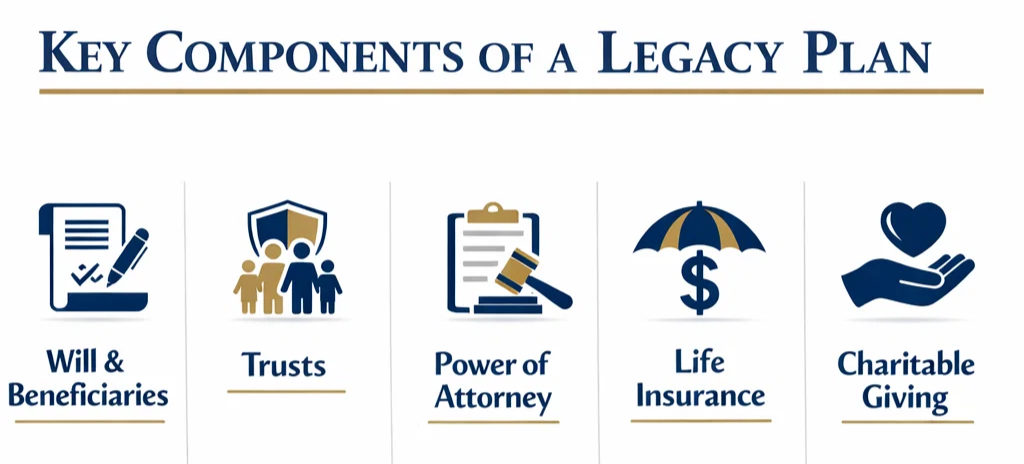 The key components of a legacy plan depend on a family’s goals, assets, and relationships.
A complete plan may include legal documents, account instructions, trust planning, charitable giving, family communication, and guidance for future decision-makers.
Wills and Beneficiary Designations
A will is a legal document that explains how certain assets should be distributed after death. It may also name guardians for minor children and name an executor to handle estate responsibilities.
Beneficiary designations are also important. Retirement accounts, life insurance policies, and some bank or investment accounts may pass by beneficiary designation instead of through a will.
Families should review beneficiary designations regularly. Life changes can make older designations outdated. Marriage, divorce, births, deaths, and changes in family relationships can all affect the plan.
A will and beneficiary designations should work together. If they conflict, the result may not match the person’s wishes.
Power of Attorney and Healthcare Directives
A power of attorney names a trusted person to manage financial or legal matters if someone cannot act for themselves.
A healthcare directive, sometimes called an advance directive or living will, explains medical preferences and may name someone to make healthcare decisions.
These documents matter because legacy planning is not only about what happens after death. It also includes planning for incapacity.
Without clear documents, loved ones may have to ask a court for authority to act. That can take time and add stress during an already difficult period.
Customers should work with qualified legal counsel to prepare these documents.
Life Insurance as a Legacy Tool
Life insurance can be part of a legacy plan when it fits a family’s needs.
It may provide funds for loved ones, help cover final expenses, support a surviving spouse, provide liquidity for estate needs, or help with business and farm succession planning.
Life insurance should be reviewed alongside the rest of the plan. The policy owner, insured person, beneficiary, and purpose of the policy should all be clear.
Families should also review policies after major life events. An old policy may no longer match current goals.
Charitable Giving and Philanthropic Goals
Charitable giving can be an important part of legacy planning.
Some families want to support a church, school, local nonprofit, scholarship fund, or community cause. A legacy plan can help document those goals and coordinate giving with the rest of the estate plan.
Charitable giving may happen during life, after death, or both. The best approach depends on the family’s goals, tax situation, and available assets.
Customers should consult financial, tax, and legal advisors before making charitable giving decisions.
How to Start Legacy Planning
Knowing how to start legacy planning can make the process feel less overwhelming.
Families do not need to have every answer before beginning. The first step is to organize information and define what matters most.
Step 1: Take Inventory of Your Assets
An asset inventory helps families understand what needs to be included in the plan.
This may include:
- Checking and savings accounts
- Personal Savings Accounts
- Retirement accounts
- Investment accounts
- Life insurance policies
- Real estate
- Farmland
- Vehicles
- Business interests
- Farm equipment
- Personal property
- Digital accounts
- Debts and loans
The inventory should also include account ownership, beneficiary designations, and where important documents are stored.
This step gives advisors and family decision-makers a clearer picture.
Step 2: Define Your Goals and Beneficiaries
After assets are listed, families should define goals.
Important questions may include:
- Who should inherit certain assets?
- Should assets be distributed equally or in a different way?
- Are there minor children or dependents to protect?
- Should a trust control when and how assets are used?
- Should a farm or business stay in the family?
- Are there charitable causes to support?
- Should certain personal items go to specific people?
These conversations can be sensitive. But they can also prevent confusion later.
Step 3: Choose Your Trustees and Executors
A trustee manages assets held in a trust. An executor handles estate responsibilities after death.
These roles require care, organization, and judgment. Families should choose people or institutions that can handle the responsibility.
Families may consider a corporate trustee, particularly when ongoing administration responsibilities, complex assets, or other fiduciary considerations are involved.
Springs Valley can discuss trust administration options and help families understand how a trust department may support the plan.
Step 4: Work With a Qualified Advisor
Legacy planning often involves several professionals. That may include an attorney, tax advisor, financial advisor, trust officer, and insurance professional.
Each person plays a different role.
The attorney prepares legal documents. The tax advisor helps review tax issues. The financial advisor helps coordinate assets, retirement accounts, income needs, and family goals. A trust officer may help with trust administration and fiduciary responsibilities.
Springs Valley’s Financial Advisory Group can help families organize the process and coordinate with outside professionals.
Trust Services for Estate Planning
Trust services' estate planning support can help families manage assets during life, after death, or both.
A trust is a legal arrangement that allows one party to manage assets for the benefit of another. Trusts can be used for privacy, control, incapacity planning, minor beneficiaries, family property, charitable goals, and wealth transfer.
Revocable vs Irrevocable Trust
Revocable vs. irrevocable trust planning depends on control and purpose.
A revocable trust can generally be changed or canceled by the person who created it during that person’s lifetime, as long as they have legal capacity. Depending on an individual's circumstances, it may assist with asset management, privacy, and transfer planning. Not every trust strategy is appropriate for every situation.
An irrevocable trust generally cannot be changed as easily after it is created. It may be used for specific tax, asset protection, charitable, or transfer goals.
Trust planning should be handled with qualified legal and tax advice. The wrong structure can create problems or limit flexibility.
What is a Living Trust?
What is a living trust? A living trust is created during a person’s lifetime.
A revocable living trust is often used to help manage assets and provide instructions for what happens if the person becomes incapacitated or passes away.
A living trust may help reduce court involvement for certain assets, but it must be set up and funded properly. Funding the trust means retitling or assigning assets into the trust according to legal guidance.
A trust document alone does not complete the plan. The trust must be coordinated with account ownership, beneficiary designations, and other estate documents.
Testamentary Trusts for Minor Beneficiaries
A testamentary trust is created through a will and takes effect after death.
This type of trust may be used when beneficiaries are minors or when assets need to be managed over time. It can give instructions for how money should be used for education, health, support, or other needs.
Families with children or grandchildren may want to ask legal counsel whether a testamentary trust fits their goals.
This can be helpful when a family wants to provide support but does not want a young beneficiary to receive assets outright before they are ready.
How Springs Valley’s Trust Department Supports a Plan
Springs Valley’s Trust Department may serve as trustee, provide trust administration, fiduciary services, and coordination with a family's legal and tax advisors, subject to applicable agreements, account acceptance, and fiduciary requirements.
Trust administration can include carrying out trust terms, managing trust assets, keeping records, making distributions, and communicating with beneficiaries.
This work requires accuracy and care. A trust department may provide administrative continuity and fiduciary services in accordance with applicable governing documents and fiduciary obligations when family members are grieving, busy, or unsure how to manage the responsibility.
Customers can contact Springs Valley Bank & Trust to ask about trust services and how Springs Valley’s Financial Advisory Group supports legacy planning.
Family Legacy Planning
Family legacy planning helps families prepare for the transfer of assets, responsibilities, and values.
In rural communities, this often includes farmland, family businesses, homes, equipment, and long-held property.
Farm Succession Planning
Farm succession planning is one of the most important legacy planning topics for many rural families.
A farm may be both a business and a family legacy. That can make transfer decisions complex.
Families may need to consider:
- Who wants to operate the farm?
- Who owns the land?
- How should non-farming heirs be treated?
- How will equipment and operating assets transfer?
- Will the farm need financing during the transition?
- What happens if a key family member becomes disabled or passes away?
- How can the plan reduce conflict?
Farm succession strategies vary significantly based on ownership structure, family circumstances, financing arrangements, tax considerations, and applicable law. Families should consult qualified legal, tax, and financial professionals before implementing a succession strategy.
Estate Planning for Families in Indiana
Estate planning for families should reflect real family needs.
Some families need basic documents. Others need trusts, business succession plans, charitable giving strategies, or support for a family member with special needs.
Indiana families should work with qualified legal counsel to understand state-specific estate rules. Springs Valley’s Financial Advisory Group can help coordinate financial planning conversations but does not replace legal or tax advice.
A complete plan should be reviewed after major life changes. That includes marriage, divorce, birth, adoption, death, retirement, disability, business sale, inheritance, or major property purchase.
Generational Wealth in Rural Communities
Generational wealth in rural communities often looks different from wealth in larger cities.
It may include land, equipment, small businesses, family homes, retirement accounts, savings, and strong community ties.
Legacy planning helps families decide how those assets and values should carry forward.
For a local business owner, that may mean transferring ownership over time. For a farm family, it may mean keeping land productive. For retirees, it may mean supporting children, grandchildren, and local causes.
Working With a Legacy Planner
Working with a legacy planner can help families move from good intentions to a clear plan.
A planner can help organize goals, identify gaps, and coordinate with other professionals.
What to Look for in a Trust and Estate Advisor
A trust and estate advisor should be clear, patient, and experienced with family planning issues.
Families may want to look for an advisor who can:
- Explain trust and estate concepts in plain language
- Work with legal and tax professionals
- Review retirement and IRA beneficiary planning
- Support family conversations
- Understand rural assets and family-owned businesses
- Help coordinate trust administration
- Focus on the family’s goals, not a generic plan
Good planning takes time. Families should not feel rushed through major decisions.
How Springs Valley Walks Customers Through the Process
Springs Valley’s Financial Advisory Group helps customers start with the basics.
That may include reviewing assets, identifying current documents, discussing beneficiaries, explaining trust options, and helping families prepare for conversations with attorneys and tax professionals.Springs Valley Bank & Trust Financial Advisory Group can help with any of these steps.
The process is practical. First, customers organize what they have. Then they define what they want. After that, advisors help identify the tools and next steps that may support the plan.
Legacy planning is deeply personal. It involves family, values, property, money, and future decisions. The right support can make those conversations clearer.
Contact Springs Valley Bank & Trust to schedule a conversation with Springs Valley’s Financial Advisory Group about legacy planning, trust services, and estate planning support.
Investment and advisory services are not deposits; not insured by the FDIC; not a deposit or other obligation of, or guaranteed by, Springs Valley Bank & Trust Company; not insured by any Federal Government Agency; and may lose value, including possible loss of principal
This content is provided for general informational and educational purposes only and should not be considered individualized financial, investment, tax, legal, or estate-planning advice. The information presented does not take into account the specific financial circumstances, objectives, or risk tolerance of any individual. Readers should consult their own legal, tax, financial, or other professional advisors before making decisions based on this information.
FAQs
What is Legacy Planning And Why is It Different From a Will?
Legacy planning is a broader strategy for organizing, protecting, and passing on assets, values, and wishes.
A will is one part of that plan. It helps explain how certain assets should be distributed after death. Legacy planning may also include trusts, powers of attorney, healthcare directives, life insurance, charitable giving, beneficiary designations, and family conversations.
Springs Valley’s Financial Advisory Group helps families look at the full picture, not only one document.
What Is a Revocable Trust and How Does It Help With Legacy Planning?
A revocable trust is a trust that can generally be changed or canceled during the creator’s lifetime, as long as the creator has legal capacity.
It may help manage assets, support incapacity planning, and guide how assets should be distributed after death.
A revocable trust should be prepared with legal counsel and coordinated with beneficiary designations, account ownership, and other estate documents.
When Should Families Start Legacy Planning?
Families should start legacy planning before a crisis makes decisions urgent.
Common triggers include marriage, children, property ownership, business ownership, retirement planning, inheritance, health changes, or a desire to support charitable causes.
Starting early gives families more time to review options and update the plan as life changes.
What Happens Without a Legacy or Estate Plan?
Without a clear plan, state law and court processes may determine how certain assets are handled. That may not match the person’s wishes.
Loved ones may also face more uncertainty, delays, and conflict.
Families should work with qualified legal counsel to understand how state rules may apply to their situation.
How Do Families Pass on Farmland or an Agricultural Business?
Farm succession planning may involve land ownership, operating assets, equipment, business structure, heirs who farm, heirs who do not farm, financing needs, and tax considerations.
Families may use trusts, buy-sell planning, gifting strategies, business agreements, or other tools, depending on legal and tax guidance.
Springs Valley can help farm families discuss planning goals and review agricultural financing when financing is part of the transition.
What is a Power of Attorney and Why is It Part of Legacy Planning?
A power of attorney is a legal document that names a trusted person to handle financial or legal matters if someone cannot act.
It is part of legacy planning because incapacity can happen before death. Without this document, family members may need court approval to act.
Customers should work with legal counsel to prepare a power of attorney that fits their needs.
Can Springs Valley Help Set Up a Trust?
Springs Valley’s Financial Advisory Group includes trust services and support for trust administration, estate planning and administration, and fiduciary responsibilities.
Customers should work with legal counsel to create trust documents. Springs Valley can help administer trusts and coordinate financial planning support as part of the broader plan.
For families asking what is legacy planning, the answer is simple but important. It is the process of protecting assets, documenting wishes, choosing trusted decision-makers, and helping loved ones carry forward the values and resources built over a lifetime.